Corporate Actions & Portfolio Update Guide
Corporate Actions & Portfolio Update Guide
Corporate actions like bonus, split, merger and demerger do not change your overall investment value, but they do impact the number of shares held in your demat account and price per share of the security. To maintain accurate P&L and valuations, your portfolio may need to be updated.
How to Update Portfolio Entries
Your portfolio is auto-updated in the event of a stock split, bonus or merger. For certain corporate actions like a demerger or capital reduction, you’ll have to manually update your portfolio using either of the following methods:
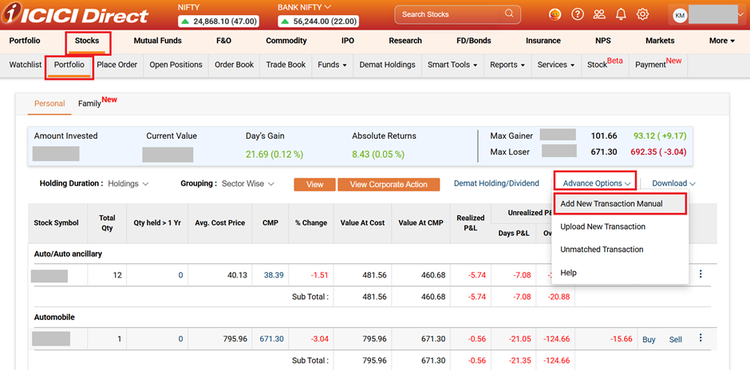
Option 1: Through Advance Options
Path: Stocks → Portfolio → Advance Options → Add New Transaction Manual
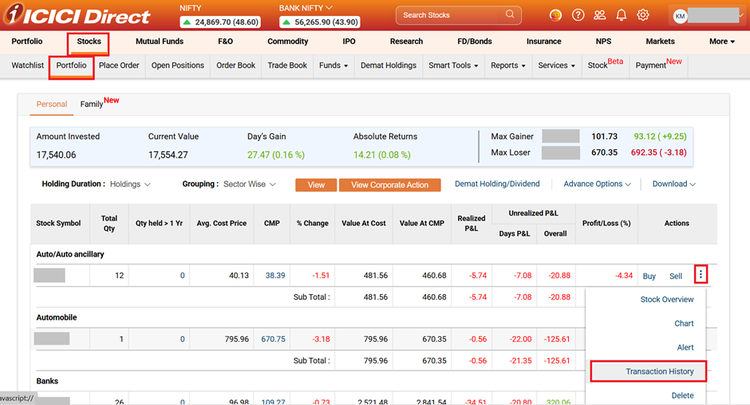
Option 2: Through Transaction History
Path: Stocks → Portfolio → Click on 3 dots under ‘Actions’ for the stock → Transaction History → Add Transaction
Impact of Corporate Actions Explained
A. Bonus / Stock Split
Effect: The number of shares held in your demat account for the security increases, based on the bonus or split ratio and the price per share reduces proportionally.
Credit Timeline: The timeline for the bonus shares to be credited to Demat account may vary.
Impact: A temporary drop in P&L is likely till the extra shares are credited.
Action Required to Update portfolio:
No action is required at your end. Bonus and split entries are auto-updated in your portfolio.
B. Demerger
Effect: Shares of the newly formed company will be credited in your demat account. The quantity and price of the demerged company will change.
Credit Timeline: Shares of the newly formed company will be credited to your demat account after all due approvals are received from the demerged company. There are no fixed timelines for the credit of shares.
Impact: The price and quantity of demerged company will change as per the ratio announced by the Company. The Price and quantity of the newly formed company will have to be updated by manually adding entries in your portfolio.
Example: A Ltd. demerges into A Ltd. and B Ltd.
• Transaction history of A Ltd. as on the record date is as shown in the table below:
• Demerger Ratio: 1:5 → You receive 500 shares of B Ltd.
• Cost Apportionment: 80% to A Ltd., 20% to B Ltd.
Action Required to Update portfolio:
Yes, entries have to be manually updated in Portfolio.
Steps:
1. Identify your holding in A Ltd. as on the record date.
2. Apply the cost apportionment % to split the total cost between A Ltd. and B Ltd. (Refer to the table below to understand how to calculate this)
3. Add a Buy transaction for B Ltd.:
• Quantity = A Ltd. shares × demerger ratio (e.g., 40 × 1/5 = 8)
• Price = (Total cost × 20%) ÷ Quantity
4. Adjust A Ltd.’s transactions by placing contra-sell entries of existing transactions and a buy entry to reflect the revised cost (80%).
• Quantity for the Buy entry will be the same as the quantity of A Ltd. you held as on the record date.
• Price of Buy entry = Price of contra-sell entry x 80%
C. Merger
Effect: Shares of the new company will be credited to your demat account as per the ratio that the company has announced.
Credit Timeline: Shares will be credited after all due approvals are received. There are no fixed timelines for the credit of shares.
Impact: The quantity and price of the merged entity will change as per the ratio. The shares of the company which ceases to exist will be removed from your portfolio and the shares of the merged entity will be added to your portfolio.
Example: X Ltd. and Y Ltd. merge into Y Ltd., and X Ltd. will no longer exist after the merger
• You hold: 100 shares of X Ltd. @ ₹500 = ₹50,000
• Merger Ratio: 5:2 → You receive 40 shares of Y Ltd.
➤ Action Required to Update portfolio:
No action required at your end.
D. Rights Issue
Effect
Eligibility for Rights Entitlement (RE) shares is based on the number of shares you hold in the company announcing the rights issue.
These RE shares must be manually updated in your portfolio.
They are temporarily listed and will lapse automatically once the rights issue closes.
Credit Timeline
RE shares are credited to your Demat account one day before the rights issue opens.
To know how to apply for a Rights Issue, click here.
Impact on Your Portfolio
If you apply for the rights issue and receive an allotment, you must manually update your existing share quantity in the portfolio with the number of shares allotted.
Steps to Update Your Portfolio
1. Check your entitlement using the rights ratio and your shareholding
• Quantity = (Shares Held × Rights Ratio)
• Price = Rights Issue Price announced by the company
2. Add a Buy entry in your portfolio.
Example
Rights issue: 5:9 ratio at ₹120 per share
• Your holding: 54 shares
• Entitlement: (54 × 5) ÷ 9 = 30 shares
If You Sold Your Rights Entitlement (RE) Shares
• Add a Buy entry in your portfolio for the number of shares allotted to you.
• The transaction price will be zero.
• The Sell transaction for RE shares will be auto-updated in your portfolio.
✔ Action Required: Yes — manual update needed.
Summary: Action Required or Not
New process for Portfolio Update:
Additional Notes:
• When you receive shares via a bonus, split or demerger, the shares are automatically allocated to your Demat account. You do not have to allocate the shares at your end.
• When companies issue shares for corporate actions, there are actions at depository end for activation of new shares. Upon actual credit of new shares in demat account of clients, shares are automatically allocated in your demat account. Any delay in this process could result in a delay in the allocation of shares in your Demat account. In this case, you can Allocate the shares manually. This can be done by clicking on the ‘Allocate’ button on the Demat Holdings page.